- Adobe Delivers Flash Player 9 for Linux
- 2007 Open Source Catalogue
- Redfin Integrates Microsoft Maps
- openSUSE 10.2 Better than Vista
- A Technology Flip Test: Introducing Channels in a World of Platforms
The Road to KDE 4: Full Mac OS X Support
Published By: Vichar Bhatt on January 17, 2007 - 7:19am
Original Blog Entry Located Here
Filed In: Platforms
Original Blog Entry Located Here
Filed In: Platforms
Just because KDE has been designed to be portable across Linux, FreeBSD and other UNIX/X11 environments for an age now, doesn’t mean we aren’t up for the occasional challenge. With version 4, Trolltech released Qt for the Mac, Windows and now even embedded environments under the GPL. Since Qt is the base upon which KDE is developed, KDE is now free to offer native support for these platforms. Today I am focusing on the KDE/Mac developments for KDE 4. Read on for the details.
Before I begin, I’d like to discuss some branding issues that KDE has had to face in previous releases. With KDE 3, does the term “KDE” refer to the Desktop Environment (KWin, Kicker, kdesktop, etc.) and if so, would it still be reasonable to refer to the Mac OS X port as “KDE” even if it was without these key desktop components? Or, is “KDE” a reference to the project as a whole, in which case we can still call Konqueror a “KDE application” whether it is running on Mac, Windows, or in Enlightenment…
These are some branding issues that have been discussed for KDE 4. The resulting decision has been to refer to “KDE” as the umbrella that refers to all things KDE. So, as a result, we have KDE Applications, the KDE Development Environment (libraries and technologies), and the KDE Workspace (this consists of KWin, Plasma, etc.) that refer to the three main components that make up the collection of KDE software. When referring to just “KDE” by itself, you therefore refer to all things KDE.
This also solves some issues with alternate release schedules for some applications. For example, Amarok has often released on a different schedule from KDE, and so some people have not considered it as part of KDE proper. Amarok for KDE 4 will be more clearly labelled as a “KDE Application” without the related implications of it being restricted to a given desktop environment. In KDE 4, Amarok is a KDE product, even if it is based on its own release cycle. As Amarok lead developer Mark Kretschmann says, “If Amarok convinces more people to use KDE technologies, that’s perfect. If they use Amarok under other desktop environments like GNOME or Mac OS X, that’s still nice for us.”
Since this article deals with KDE on other platforms than X11, we need a way to distinguish between KDE for X11 and KDE for Mac. So, with the approval of some of the developers, I’m going to use the following terminology: KDE/X11 will refer to all KDE Applications that run on X11, the Development Environment on X11, and the KDE Workspace on X11. Likewise, KDE/Mac will refer to KDE applications that run on the Mac, the KDE Development Environment on the Mac, and since the workspace is not required on the Mac, it is not included here. Ditto for Windows. It is important to realize, however, that these distinctions are based on a subset of features that are available on each platform, and that for the most part the source code is identical, and there are not separate source trees for each platform. There are no forks or haphazard ports.
New KDE Development Environment technologies like Phonon and Solid will help ease this transition, since the platform-integration work will happen at the library level. KDE Applications need not be aware of the differences that might exist in the OS platform.
What is KDE/Mac?
KDE/Mac is the collection of KDE Applications that run natively on the Mac, including the underlying technologies, libraries, etc. that make these KDE Applications work. There are only a few differences between KDE/X11 and KDE/Mac. Most notably, the KDE Workspace elements, such as KWin and Plasma are not present for the Mac. The reason for this is that the functionality of KWin and Plasma already exist in OS X in one form or another, and reimplementing them would not allow for close integration of KDE Applications alongside existing Mac Applications. So instead, KDE has elected to not port the KDE/X11 Workspace to the Mac.
Since the beginning of KDE, its applications have been designed in such a way as to peacefully co-exist in other UNIX Desktop environments. Initially this meant Window Maker, and then later GNOME and Enlightenment. The KDE Applications use shared standards (such as those crafted at FreeDesktop.org), capable of sharing clipboard data, system tray icons, and so on without any issues on these compliant platforms. Now, because of the additional portability that Qt 4 offers, this same peaceful co-existence will also be true for non-X11 environments, such as the Mac.
KDE apps have been able to run on the Mac before, using Apple’s X11 server layer that is built into OS X - however, KDE was still using Qt/X11 and as such, these applications simply looked identical to how they would look in good old KDE/X11 proper. The fact that they ran at all is thanks to the excellent efforts of the Fink project. If you’re interested in running other UNIX programs on OS X, check this project out.
(For a time there was also a Qt/Mac Freeware edition which allowed some experimentation with a true KDE/Mac experience within the KDE 3.x series. However, The KDE/X11 version in Fink was usually used due to its stability.)
Here’s a screenshot of a KDE application as it looked using KDE 3.5 and the Fink project’s packages. Click for the full version.
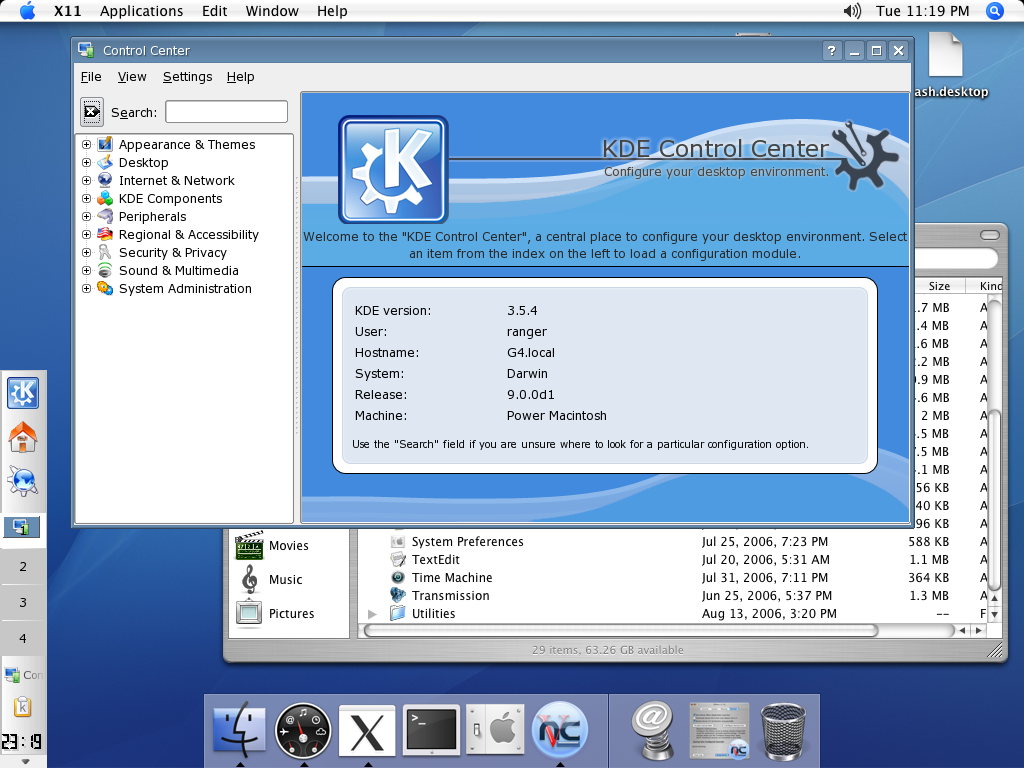
Because the above was developed for Qt/X11, the whole KDE environment was able to run. The downside, however, was that it did not integrate well with the Mac, so it felt like you were running two totally different computer systems on one screen. Of course, KDE is all about the integration…
Bookmark/Search this post with:
| | | | | | | |
Sponsored White Paper
Recent Blog Entries
Related Blog Entries
Newsletter
Get these headlines/links in a daily e-mail newsletter.
Sponsored Links
User login
- Create new account
- Request new password
Navigation
Browse archives
| Su | Mo | Tu | We | Th | Fr | Sa |
|---|---|---|---|---|---|---|
| 1 | 2 | 3 | 4 | 5 | 6 | |
| 7 | 8 | 9 | 10 | 11 | 12 | 13 |
| 14 | 15 | 16 | 17 | 18 | 19 | 20 |
| 21 | 22 | 23 | 24 | 25 | 26 | 27 |
| 28 | 29 | 30 | 31 |