SPARK06
I have intercepted a curious e-mail the other day. It was forwarded by our Chief Architect and VP of Middleware, Ted Farrell. The opening sentence included the word "manifesto". Having grown up in the old Eastern Block I became somewhat concerned. This faded quickly as I read more about a Microsoft conference where the organizers were hoping to generate a manifesto or a new common vision. It was going to be a caucus of about two-dozen software architects. SPARK06 was the official name and Las Vegas was the place. I decided to take the gamble and I signed up. The idea was to look at emerging consumer trends, namely the ones that are part of Web 2.0 and map them onto an enterprise or business setting. Blogging, tagging, sharing pictures, mash-ups, and folksonomies are gaining momentum, not to mention the hipness quotient, but how would these trends be represented in the design of scalable, secure, and easy to deploy and monetize enterprise architectures?
We had an excellent cross section of participants. The CTO of MySpace (who later delivered part of a Bill Gates keynote for the next conference, MIX06), two Gartner analysts, a senior Google developer, an architect from British Telecom, and a host of other luminaries, pundits, and software leaders. Kudos to MSFT for getting great facilitators. They actually used a "Wants and Needs with Card Sort" usability technique to get at the components of the manifesto. A big thanks for providing most excellent catering for this weekend event. Quality of the participants and food yielded constructive results!
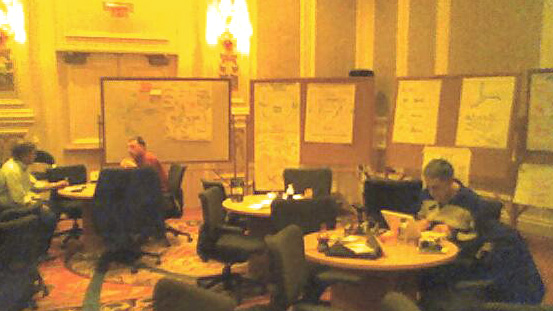
Some of the themes that emerged were around industry standards needed to drive adoption and interoperability. Others centered on enabling organic communities. The latest Long Tail phenomenon was analyzed. We also looked at inhibitors like lagging legal and software licensing infrastructures. Security of mash-ups, and policing content quality and classification structures also emerged as considerations in taking Web 2.0 technologies to the next level. A common model that included a relationship diagram of some of these components was presented at one of the tracks during the follow up MIX conference. A PPT is linked in from the SPARK06 web site.
I found the SPARKO6 conference in Vegas to be very productive. The MIX06 follow up was in turn educational. WPF (Avalon, renamed), Atlas (MSFT's AJAX toolkit), and the new connection between the designer and the developer in the tooling provided great insight into the next generation of user interfaces from Microsoft. Being able to play with Office 12 in the demo grounds was great, too. I have only seen it demonstrated at BayCHI by Jensen Harris. It was impressive that Microsoft entrusted a user experience visionary to help drive the future of an entire suite. A similar realization or transition is taking place at Oracle. User experience is a core competitive differentiator for Oracle Fusion Applications. The VP driving this (Jeremy Ashley) reports directly to John Wookey. Jeremy has a key role in the development process. You can read more about this in an upcoming issue of Profit magazine.
Our applications and tools need to work well in a multi-vendor environment. Hardly anything these days is a "green field" sale. A recent issue of Oracle magazine focused specifically about Oracle being the #1 database on MSFT Windows and presented the available tools, interop areas, and synergies between Microsoft and Oracle. See more about Powering Windows online. On the user experience side we realize that Microsoft Office is extremely popular with our own E-Business Suite customers, and we recently authored the Oracle Middleware / MS Office Developer Guide. Find it on our Oracle Fusion Middleware and Microsoft Interoperability pages. I turns out that we have many more touch points than some of our direct competitors!
I have no manifestos about the future of user interfaces, but thanks to the two conferences I do have a deeper understanding of how we can tap the latest trends and consumer UI directions in our own software.
Next installment will also detail a design synergy and an eye opening User Interface experience. I just cannot name names yet...
Bookmark/Search this post with:
| | | | | | | |
Trackback URL for this post:
IOS Access Control Lists Made Easy This paper is for readers with any level of ACL experience, providing novices with appreciation and understanding of what goes into the definition of an ACL and giving experts additional insight.
Keeping Backup Simple: Purchasing the Right Systems To put it simply, data protection is complicated. Simplifying it involves assessing solutions for their near-term and long-term value. This paper examines the less obvious- but not less important - issues in simplifying backup.
The Value of Compliance This paper defines the cost advantages of the Reference Information Storage System (RISS) when applied to email systems in general and when applied to specific functions such as electronic evidence discovery (EED) or regulatory compliance. Download this paper to learn more.
About This Author
Name: Luke Kowalski
Company: Oracle
Job Title: Corporate UI architect
Bio: Luke Kowalski is the corporate UI architect at Oracle. His role serves to bridge the user interface (UI) design groups at Oracle, and he works as an evangelist for effective UI technology, on legal aspects of user interfaces, business context and partnerships, as well as cross-divisional information architecture integration. Before coming to Oracle, he worked for various startups as director of UI and Web, as well as for Netscape's Server and ECommerce divisions. He holds several UI patents, a CPE Certification, and serves as an ISO representative for US through ANSI. His educational background includes advanced degrees from UTA, Pratt Institute, and Columbia University.
Poll
Syndicate
New Bloggers
Popular Topics
Recent Blog Entries
- Radio Handi - Party Line for Planet Earth
- Metrics for XML Projects #1: Element and Attribute Count
- Metrics for XML Projects #2: Production Count
- Metrics for XML Projects #3: XML Mapping Completeness Ratio
- Metrics for XML Projects #4: XML Mapping Additions Ratio
Sponsored Links
User login
- Create new account
- Request new password
Navigation
Browse archives
| Su | Mo | Tu | We | Th | Fr | Sa |
|---|---|---|---|---|---|---|
| 1 | 2 | 3 | 4 | 5 | 6 | |
| 7 | 8 | 9 | 10 | 11 | 12 | 13 |
| 14 | 15 | 16 | 17 | 18 | 19 | 20 |
| 21 | 22 | 23 | 24 | 25 | 26 | 27 |
| 28 | 29 | 30 | 31 |